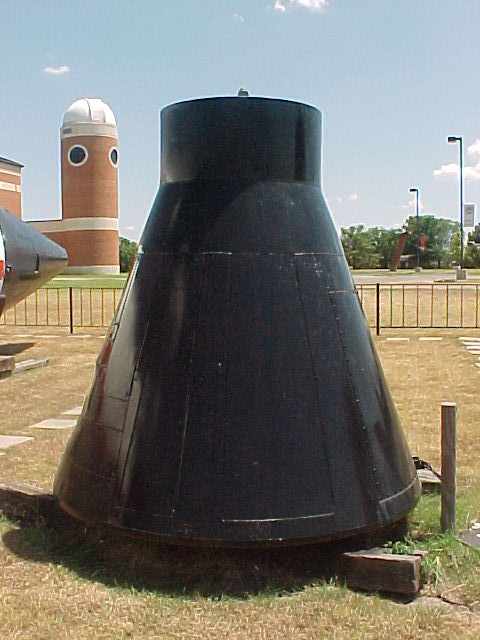

United States
- Capsule used in unmanned test (additional details unknown)
Kennedy Space Center, Cape Canaveral, FL
- Mercury 14 (capsule used in unmanned test)
Virginia Air and Space Center (NASA Langley visitor’s center), Hampton, VA
(original shell only)
- Capsule #4 (used in unmanned test MA-1; launched 7/29/1960)
Kansas Cosmosphere and Space Center, Hutchinson, KS
(recovered after Atlas rocket exploded shortly after launch)
- MR-2 (chimpanzee "Ham"; launched 1/31/1961)
California Science Center, Los Angeles, CA
- MA-5 (chimpanzee "Enos"; launched 11/29/1961)
North Carolina Museum of Life and Science, Durham, NC
- MR-3 "Freedom 7" (Shepard)
John F. Kennedy Presidential Library and Museum, Boston, MA
(temporarily on loan from the
National Air and Space Museum (Smithsonian Institution), Washington, DC)
- MR-4 "Liberty Bell 7" (Grissom)
Sank after splashdown in the Atlantic Ocean;
recovered from the sea floor, July 20, 1999
The Children's Museum of Indianapolis, Indianapolis, IN
- MA-6 "Friendship 7" (Glenn)
National Air and Space Museum (Smithsonian Institution), Washington, DC
- MA-7 "Aurora 7" (Carpenter)
Museum of Science and Industry, Chicago, IL
- MA-8 "Sigma 7" (Schirra)
Astronaut Hall of Fame, Titusville, FL
- MA-9 "Faith 7" (Cooper)
Space Center Houston (NASA Johnson Space Center’s Visitor Center), Houston, TX
- Capsule #10 (unflown backup)
Kansas Cosmosphere and Space Center, Hutchinson, KS
(original shell; restored interior)
- Mercury 12B (unflown backup for MA-8)
National Air and Space Museum - Garber Facility, Suitland, MD
- Mercury 19 (unflown backup)
McDonnell Planetarium, Saint Louis, MO (on loan from the Smithsonian Institution)
- MA-15B (unflown - was to have been MA-10 (Shepard))
National Air and Space Museum:
Steven F. Udvar-Hazy Center, Chantilly, VA.
- Mercury 17 (unflown backup)
U.S. Air Force Museum, Wright-Patterson Air Force Base, Dayton, OH
- an engineering mockup
James S. McDonnell Prologue Room, Boeing Corporation, Saint Louis, MO
- An engineering 'boilerplate'
(photo)
Cook Arts, Science & Technology Center, Corsicana, TX
- 2 (unmanned test flight)
Cape Canaveral Air Station, FL
- 3 "Molly Brown" (Grissom, Young)
Grissom Memorial Museum, Mitchell, IN
- 4 (McDivitt, White)
National Air and Space Museum (Smithsonian Institution), Washington, DC
- 5 (Cooper, Conrad)
Space Center Houston (NASA Johnson Space Center’s Visitor Center), Houston, TX
- 6-A (Schirra, Stafford)
Oklahoma History Center, Oklahoma City, OK
- 7 (Borman, Lovell)
National Air and Space Museum:
Steven F. Udvar-Hazy Center, Chantilly, VA.
- 8 (Armstrong, Scott)
Neil Armstrong Museum, Wapakoneta, OH
- 9-A (Stafford, Cernan)
Kennedy Space Center, Cape Canaveral, FL
- 10 (Young, Collins)
Norwegian Technical Museum, Oslo, Norway
(Also, one of the hatches is on display at the Virginia Air and Space Center (NASA Langley visitor’s center), Hampton, VA)
- 11 (Conrad, Gordon)
California Science Center, Los Angeles, CA
- 12 (Lovell, Aldrin)
Alder Planetarium, Chicago, IL
- Capsule SC-2A (unflown backup)
Kansas Cosmosphere and Space Center, Hutchinson, KS
(original shell; restored interior)
- (for the cancelled Air Force "Manned Orbiting Laboratory" - unflown)
U.S. Air Force Museum, Dayton, OH. (Has a circular hatch in the heat shield for entering the MOL)
- TTV-1 "El Kabong 1" (unmanned "towed test vehicle", used in the Gemini Paraglider Program)
National Air and Space Museum:
Steven F. Udvar-Hazy Center, Chantilly, VA.
- TTV-2
Museum of Science & Industry, Manchester, England, U.K.
- (an unflown mockup, used for training)
Michigan Space Center, Jackson, MI
- (an unflown mockup)
Museum of Science and Industry, Chicago, IL
- (a training capsule)
Louisville Science Center, Louisville, KY
- (an engineering mockup)
James S. McDonnell Prologue Room, Boeing Corporation, Saint Louis, MO
- (a full-scale model)
Oregon Museum of Science and Industry, Portland, OR
- (an unflown mockup)
Pacific Science Center, Seattle, WA
- (an unflown mockup (with landing gear))
National Museum of Scotland, Edinburgh, Scotland, U.K.
Apollo (Command Modules)
| CSM# | Flight (launcher) | Crew | Location of CM |
| 009 | AS-201 | unmanned test flight |
Strategic Air & Space Museum, Ashland, NE |
| 012 | Apollo 1 (AS-204) | Grissom, White, Chaffee (Died in accidental fire) | NASA Langley Research Center, Hampton, VA.[*] (Not on public display) |
| 017 | Apollo 4 (AS-501) | unmanned test flight | NASA Stennis Space Center, MS |
CM-020 SM-014 | Apollo 6 (AS-502) | unmanned test flight | Fernbank Science Center, Atlanta, GA.
(See also Daniel Wright’s Apollo 6 page) |
| 101 | Apollo 7 | Schirra, Eisele, Cunningham | Frontiers of Flight Museum, Dallas, TX |
| 103 | Apollo 8 | Borman, Lovell, Anders | Museum of Science and Industry, Chicago, IL |
| 104 ("Gumdrop") | Apollo 9 | McDivitt, Scott, Schweikart | San Diego Aerospace Museum, San Diego, CA |
| 106 ("Charlie Brown") | Apollo 10 | Stafford, Young, Cernan | Science Museum, London, England, U.K. |
| 107 ("Columbia") | Apollo 11 | Armstrong, Aldrin, Collins |
National Air and Space Museum (Smithsonian Institution), Washington, DC |
| 108 ("Yankee Clipper") | Apollo 12 | Conrad, Gordon, Bean | Virginia Air and Space Center (NASA Langley visitor’s center), Hampton, VA |
| 109 ("Odyssey") | Apollo 13 | Lovell, Swigert, Haise | Kansas Cosmosphere and Space Center, Hutchinson, KS |
| 110 ("Kitty Hawk") | Apollo 14 | Shepard, Roosa, Mitchell |
Astronaut Hall of Fame, Titusville, FL
|
112 ("Endeavour") | Apollo 15 | Scott, Irwin, Worden | U.S. Air Force Museum, Dayton, OH. (All three astronauts were from the Air Force.)
|
| 113 ("Casper") | Apollo 16 | Young, Mattingly, Duke | Alabama Space and Rocket Center, Huntsville, AL |
| 114 ("America") | Apollo 17 | Cernan, Evans, Schmitt | Space Center Houston (NASA Johnson Space Center’s Visitor Center), Houston, TX |
| 116 | Skylab 2 | Conrad, Kerwin, Weitz | Naval Aviation Museum, Pensacola, FL |
| 117 | Skylab 3 | Bean, Garriot, Lousma | Great Lakes Science Center, Cleveland, OH |
| 118 | Skylab 4 | Carr, Gibson, Pogue | National Air and Space Museum (Smithsonian Institution), Washington, DC |
| 111 | Apollo-Soyuz Test Project ("ASTP") | Stafford, Brand, Slayton | California Science Center, Los Angeles, CA |
| 007 | unflown test capsule | n/a | Museum of Flight, Seattle, WA |
| 119 | unflown (Skylab backup/rescue capsule) | n/a | Kennedy Space Center, Cape Canaveral, FL |
| 115 | unflown backup | n/a | NASA Johnson Space Center, Houston, TX |
| 115A | unflown backup | n/a | unknown |
| JSC#2 | unflown backup for ASTP | n/a | Kansas Cosmosphere and Space Center, Hutchinson, KS |
| 105 | unflown test capsule | n/a | National Air and Space Museum (Smithsonian Institution), Washington, DC
(Part of an ASTP display) |
| #1102a | a training module, used for water egress training | n/a | USS Hornet museum, Alameda, CA |
| ? | An engineering 'boilerplate'
|
n/a |
Cook Arts, Science & Technology Center, Corsicana, TX |
| BP-29 | An engineering 'boilerplate'
(photo)
|
n/a |
on display at the Barringer (Meteor) Crater,
near Winslow, AZ |
Note: "Skylab 1" was the name for the Skylab space station itself. This was launched on May 14, 1973, and reentered the Earth’s atmosphere on July 11, 1979. Some debris from the station landed in a sparsely populated region of Western Australia;
some pieces are on display at a museum in Esperance, Western Australia.
A large piece of debris (perhaps from an oxygen tank) is also on display at the Alabama Space and Rocket Center, Huntsville, AL.
An unflown backup of the Skylab space station is on display at the National Air and Space Museum (Smithsonian Institution), Washington, DC.
- Full-size mockup ("Pathfinder"; used for sizing tests)
Alabama Space and Rocket Center, Huntsville, AL
- OV-101 "Enterprise" (prototype, used for flight tests in the atmosphere)
Intrepid Sea, Air & Space Museum, New York, NY.
- OV-102 "Columbia"
Destroyed (with loss of crew) in
re-entry accident, February 1, 2003.
- OV-099 "Challenger"
Destroyed (with loss of crew) in launch accident, January 28, 1986. Debris stored (sealed) in old missile silo, Cape Canaveral Air Station, FL.
Note: At one point there were plans to store the "Apollo 1" CM in the same silo as the Challenger debris, but it was later decided that "Apollo 1" would remain at NASA Langley Research Center.
- OV-103 "Discovery"
National Air and Space Museum:
Steven F. Udvar-Hazy Center, Chantilly, VA.
- OV-104 "Atlantis"
Kennedy Space Center, Cape Canaveral, FL.
- OV-105 "Endeavour"
California Science Center, Los Angeles, CA
Soviet Union/Russia
Soyuz
- TMA-6
Intrepid Sea, Air & Space Museum, New York, NY.
- TM-10
National Air and Space Museum (Smithsonian Institution), Washington, DC, U.S.A.
- 29 (landing capsule for the first Soviet-East German manned spaceflight (in 1978). The crew had been launched on Soyuz 31, which remained docked at the Salyut 6 space station.)
Militärhistorisches Museum, Dresden, Germany
- 30
Military History Museum, Warsaw, Poland
- Unflown mockup
National Air and Space Museum (Smithsonian Institution), Washington, DC, U.S.A.
(Part of an "Apollo-Soyuz Test Project" display)
- ??? (orbital, command, and service modules)
National Space Centre, Leicester, U.K.
China
- Shenzhou 5 (Yang Liwei)
National Museum of China, Beijing, China
For more information
Thanks to the many readers who have contributed information for this page.
(Last modified date: 2016.11.10)
©1995-2015 Ross Finlayson.
Please email any updates/changes to "finlayson(at)live555.com".
|