#include <DelayQueue.hh>
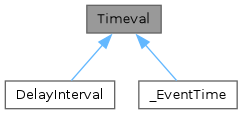
Public Member Functions | |
| time_base_seconds | seconds () const |
| time_base_seconds | seconds () |
| time_base_seconds | useconds () const |
| time_base_seconds | useconds () |
| int | operator>= (Timeval const &arg2) const |
| int | operator<= (Timeval const &arg2) const |
| int | operator< (Timeval const &arg2) const |
| int | operator> (Timeval const &arg2) const |
| int | operator== (Timeval const &arg2) const |
| int | operator!= (Timeval const &arg2) const |
| void | operator+= (class DelayInterval const &arg2) |
| void | operator-= (class DelayInterval const &arg2) |
Protected Member Functions | |
| Timeval (time_base_seconds seconds, time_base_seconds useconds) | |
Private Member Functions | |
| time_base_seconds & | secs () |
| time_base_seconds & | usecs () |
Private Attributes | |
| struct timeval | fTv |
Detailed Description
Definition at line 35 of file DelayQueue.hh.
Constructor & Destructor Documentation
◆ Timeval()
|
inlineprotected |
Definition at line 72 of file DelayQueue.hh.
References fTv, seconds(), and useconds().
Referenced by _EventTime::_EventTime(), DelayInterval::DelayInterval(), operator!=(), operator<(), operator<=(), operator==(), operator>(), and operator>=().
Member Function Documentation
◆ operator!=()
|
inline |
Definition at line 63 of file DelayQueue.hh.
References Timeval().
◆ operator+=()
| void Timeval::operator+= | ( | class DelayInterval const & | arg2 | ) |
◆ operator-=()
| void Timeval::operator-= | ( | class DelayInterval const & | arg2 | ) |
◆ operator<()
|
inline |
Definition at line 54 of file DelayQueue.hh.
References Timeval().
◆ operator<=()
|
inline |
Definition at line 51 of file DelayQueue.hh.
References Timeval().
◆ operator==()
|
inline |
Definition at line 60 of file DelayQueue.hh.
References Timeval().
◆ operator>()
|
inline |
Definition at line 57 of file DelayQueue.hh.
References Timeval().
◆ operator>=()
◆ seconds() [1/2]
|
inline |
◆ seconds() [2/2]
|
inline |
Definition at line 37 of file DelayQueue.hh.
References fTv.
Referenced by DelayInterval::DelayInterval(), and Timeval().
◆ secs()
|
inlineprivate |
◆ useconds() [1/2]
|
inline |
◆ useconds() [2/2]
|
inline |
Definition at line 43 of file DelayQueue.hh.
References fTv.
Referenced by DelayInterval::DelayInterval(), and Timeval().
◆ usecs()
|
inlineprivate |
Definition at line 80 of file DelayQueue.hh.
References fTv.
Field Documentation
◆ fTv
|
private |
Definition at line 84 of file DelayQueue.hh.
Referenced by seconds(), seconds(), secs(), Timeval(), useconds(), useconds(), and usecs().
The documentation for this class was generated from the following file:
- BasicUsageEnvironment/include/DelayQueue.hh
Generated on for live by
 1.18.0